


IMPACT INVESTING: Measuring What Truly Matters


Reflections from the Barclays Innovation Hub powered by Eagle Labs
Earlier this month, the conversations at the Barclays Innovation Hub brought together entrepreneurs, investors, academics and public-sector leaders around one central question:
How do we ensure that capital creates meaningful impact and how do we measure it?
As highlighted by the discussions led by leaders including Mark Northen, Shirley Choo, Mark Northern, Tuleeka Hazra, Tracey Rob Perera CA PMP FCMI , Zoe Lindegger , Luca Bertozzi, Monia Ben nejima , Simone Castello, and Yaniv Proselkov, PhD
impact investing is evolving beyond simply pursuing financial returns alongside social good.
It is forcing us to ask deeper questions:
What are we enabling?
Who benefits?
How many lives are improved?
What changes are created that may not show up in a quarterly report?
These questions are becoming increasingly important as society faces challenges that require patient capital, long-term thinking and broader definitions of value.

Defining Impact
At its simplest, impact means:
Did something change for the better?
But measuring that change is far from simple.
Traditional finance uses metrics such as:
IRR
EBITDA
Revenue growth
Return on equity
These are essential. However, many of humanity's greatest opportunities and challenges cannot be captured solely through financial metrics.
How do we value:
Improved mental health?
Reduced carbon emissions?
Cleaner water?
Education and opportunity?
Women's empowerment?
Time saved?
Better health outcomes?
Increased life expectancy?
Not everything that matters fits neatly into a spreadsheet.

The Five Dimensions of Impact
A useful framework asks five questions:
1. Who?
Who benefits?
Communities
Patients
Children
Farmers
Women
Future generations
2. How Much?
Measure scale:
Number of people reached
Tonnes of CO₂ avoided
Litres of clean water provided
Hours saved
Jobs created
3. How Deep?
Not all impact is equal.
Providing internet access is valuable.
Saving a life through access to healthcare is transformational.
Depth matters as much as breadth.
4. Duration
Will the change last?
Temporary improvements are valuable, but sustainable change creates compounding impact over years and generations.
5. Additionality
Would this have happened anyway?
True impact investing creates outcomes that would not have existed without the capital, expertise and support provided.

Measuring Impact
Increasingly, investors are using established frameworks such as:
UN Sustainable Development Goals (SDGs)
IRIS+ by the Global Impact Investing Network
Social Return on Investment (SROI)
B Corp assessments
ESG metrics
Yet numbers alone are insufficient.

Quantitative Metrics
Examples include:
Impact Area Metrics
Healthcare: Lives saved, patients treated
Environment: CO₂ reduced, water saved
Education: Students reached, graduation rates
Employment: Jobs created
Food Security: People fed, land restored
Mental Health: Reduction in anxiety, wellbeing scores
Qualitative Metrics
Equally important are:
Improved quality of life
Increased dignity
Hope and optimism
Community resilience
Happiness and wellbeing
Human connection
Because some outcomes cannot be measured precisely, but they can still be deeply meaningful.
Comparing Impact Investments
Financial returns are easy to compare.
Impact is more complex.
Perhaps comparison should consider three dimensions:
Financial Return
IRR, revenue growth, multiples.
Scale of Impact
How many people or ecosystems are affected?
Depth of Impact
How profound is the change?
Imagine:

Which creates the greatest value?
There is no universal answer.
Perhaps the future of investing lies not in maximising a single number, but in optimising across multiple forms of return.

From IRR to Human Return
Conversations after the conference repeatedly came back to:
How do we define, rate, compare and measure impact?

Some of the most important work in society may never produce venture-scale returns.
It requires:
Patient capital.
Long time horizons.
Collaboration between business, academia and government.
Investors willing to measure success in lives changed rather than simply percentages achieved.
Perhaps impact investing is not about choosing between profit and purpose.
That's an important observation and one that came up repeatedly in many conversations around impact investing.
Impact Is Not a Substitute for a Business Model
One recurring theme from the discussions at the Barclays Innovation Hub was both simple and profound:
For a purpose-driven venture to succeed, it must first stand as a solid investment in its own right. Purpose and impact are the bonus—not the substitute.
Too often, founders assume that because a venture addresses an important problem, capital will naturally follow. But investors, even impact investors, still need confidence that the underlying economics make sense.
The reality is that impact does not compensate for weak fundamentals.
A venture solving climate change, improving mental health, democratizing education or providing clean water still needs:
A clear value proposition.
A scalable business model.
Strong management.
A path to profitability or sustainability.
Competitive advantages.
Measurable outcomes.
Without these, even the most worthy causes struggle to attract capital.
The most successful impact investments share a common characteristic:
They would be attractive businesses even without their impact story.
The impact becomes an additional source of value rather than the primary reason to invest.
A great business plus impact creates a powerful combination:
Strong Economics + Strong Impact = Attractive Investment
Whereas:
Weak Economics + Strong Impact = Difficult Fundraise
Investors want to avoid what could be called "charity disguised as venture capital."
There is a place for philanthropy, grants and patient capital, but venture and growth investors ultimately need businesses that can sustain themselves and generate returns.

Purpose Without Profit Is Fragile
Purpose-driven companies often underestimate this reality.
Impact is difficult to scale if the enterprise itself is not sustainable.
After all:
A company that goes bankrupt helps nobody.
A water technology that never reaches commercial scale cannot clean rivers.
A breakthrough health innovation without a viable business model will never reach patients.
A mental health platform without recurring revenues will struggle to serve future generations.
Profit is not the enemy of purpose. Profit is often what allows purpose to endure.

The Best Impact Investments Create Three Returns
Perhaps the future lies in evaluating investments across three dimensions:
1. Financial Return
Can the venture generate sustainable economic value?
2. Societal Return
How many lives are improved and to what extent?
3. Systemic Return
Does it create lasting change and improve entire ecosystems?
When these three align, impact investing moves beyond charity and becomes a force capable of solving some of humanity's greatest challenges.

As one theme repeatedly emerged throughout the day:
Impact alone rarely gets funded. Great businesses with meaningful impact do.
And perhaps that is the evolution of impact investing. Not choosing between purpose and profit, but recognising that lasting impact requires both.
Because changing the world is easier when the business model works.
Purpose and profit are not opposing forces. In many ways, profit is what allows purpose to endure. Sustainable businesses create sustainable impact.
If we can build ventures that generate attractive returns while improving lives, strengthening communities, and preserving our planet for future generations, then we are off to a fantastic start. It sounds obvious but experience says otherwise.
Ultimately, success should not be measured solely by what we accumulated, but by what we enabled, what we improved, and what we left behind.

Perhaps the greatest legacy any investor, entrepreneur, or leader can hope for is that future generations will say:
"Because they were here, something became better."
And that is a return worth striving for.


Inspired by conversations and insights shared at the Barclays Innovation Hub powered by Eagle Labs, and by reflections from Iwona Kerr , Jonas Grau Thomsen, Paulina Tenner , Rushab Shah 🐝 , Dorota Cloke , Joss Tasker, Siyun Wang , Ian Au , Alexandra Kader Christelle Salama, Dr Iain Price (PhD) and Jen Smith The event brought together founders, investors, researchers and ecosystem builders exploring how capital can create meaningful and measurable societal change.
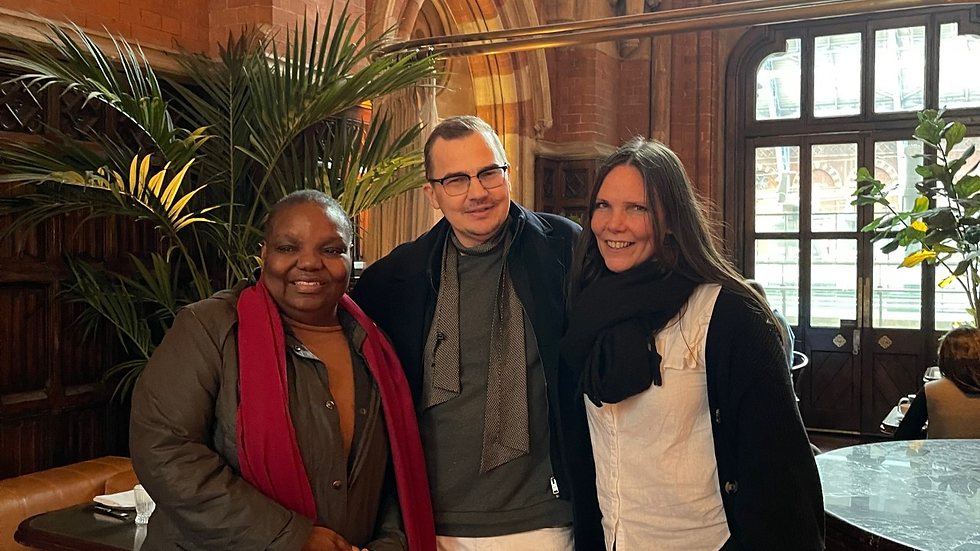
Thank you Shirley Choo for inviting me and for creating such a beautiful event bringing together so many wonderful people in one room.
#ImpactInvesting #PatientCapital #PurposeDrivenCapital #ESG #SDGs #SocialImpact #Innovation #Barclays #EagleLabs
Stone Capital Group & Partners are involved in various impact projects and ventures around the world; from building schools for girls (and boys and vocation training ) in Zimbabwe, to making Cooking bags in Lesotho that empowers women and reduces carbon emissions, to sustainable energy projects and revolutionary clean water technology and also supporting smaller impact ventures around the world focusing on elevating humanity. Join us, and our eco system as a strategic partner, investor, or expert.


Comments